
Severn Wood Flooring has repaired hardwood floor water damage in Severn, MD for 20+ years, serving surrounding cities including Jessup, Elkridge, Odenton, Glen Burnie and Linthicum. We trace where the water came from, dry the floor while reading it with a moisture meter, document the damage room by room for the adjuster, and then repair, replace or refinish what the water actually reached. The estimate is written and itemized so it can sit in an insurance file as easily as in your own records.
Water damage is the job where acting too fast and acting too slowly both cost money. A floor sanded before it has dried ends up crowned, and a floor left wet for weeks can grow mold underneath and lose boards that could have been saved. Our job is to measure the floor through drying and tell you, with numbers, when it is ready for the next step.
Most calls start with a burst pipe, an appliance leak, a failed sump pump in a finished basement or water from an upstairs unit. Each one damages the floor from a different direction, so each one is dried and repaired a little differently.
Signs Of Water Damage In Hardwood Floors
Cupping, Crowning And Buckling
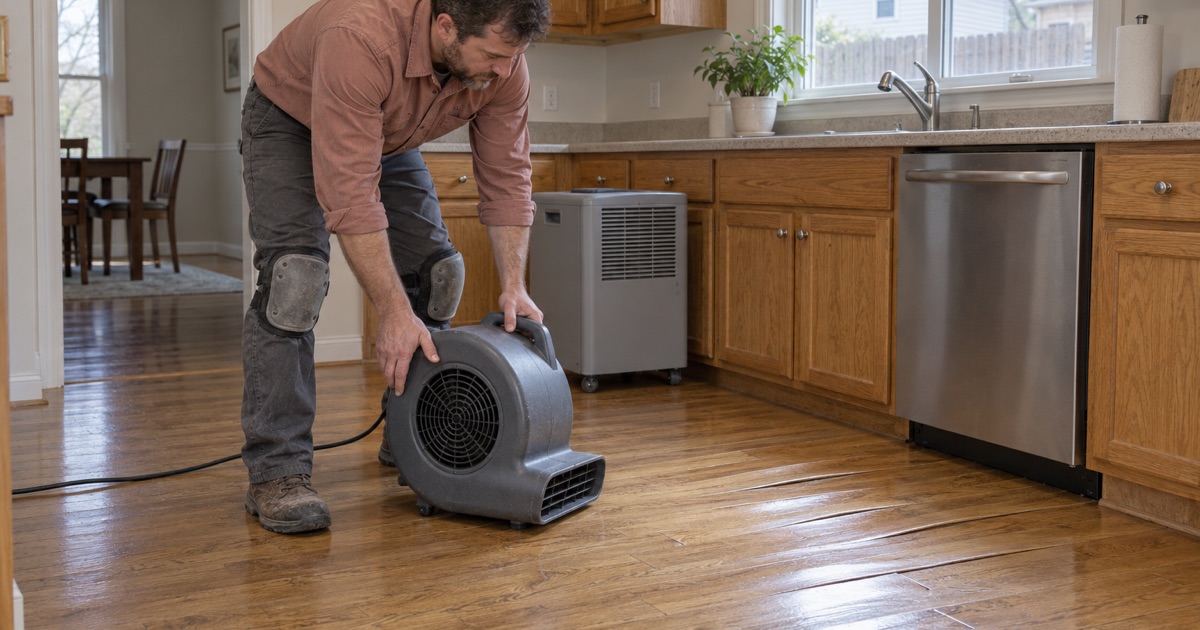
Cupping shows up when the edges of each board rise above its center, because the underside has absorbed more moisture than the face. Crowning is the reverse, often caused by sanding a cupped floor before it dried. Buckling is the most severe form: the floor swells enough to lift off the subfloor, sometimes several inches in one spot.
Each of these tells us how much water the wood took on and where it came from. Cupping across a whole room points to moisture from below, such as a damp basement or crawlspace, while a buckled patch near a dishwasher points to a single leak.
Water Stains And Black Marks
White or cloudy marks usually sit in the finish and often sand out. Gray stains have reached the top of the wood. Black stains mean water has soaked into the board and reacted with the tannins in the wood, especially in oak, and sanding cannot remove them.
We map the stains before drying starts, because their size and color tell us how far the water spread under the finish and which boards are likely to need replacement.
Gaps, Soft Spots And Odor
Boards that separate after drying, spots that feel soft or spongy underfoot and a musty smell all point to damage below the surface. A soft spot can mean the subfloor has swollen or begun to rot, and a persistent odor can mean water is still trapped under the floor. Those floors need to be opened rather than refinished.
Drying And Measuring The Floor
Stopping The Source
No floor can dry while water is still reaching it. We look for the source with you: a supply line, a dishwasher, a toilet seal, a window or door, a sump pump, or a slab wicking ground moisture. Where the fix belongs to a plumber or a waterproofing contractor, we say so and wait for that repair before anything else.
The pattern of damage is often the best clue. A wet strip along an exterior wall suggests a window, a door or a grading problem outside, while damage spreading out from a cabinet base points to a supply line or a drain under the sink.
Moisture Readings Room By Room
We take moisture readings across the wet area and in an unaffected part of the same floor, which gives a baseline for what dry means in your house. The readings are dated and recorded on a floor sketch, and we repeat them through drying so you and the adjuster can see the progress.
Those numbers decide what happens next. A floor that returns close to its baseline can often be flattened and refinished, while one that stays wet or has damaged the subfloor needs boards removed.
Air Movement And Dehumidification
Drying hardwood means pulling moisture out of the wood and the subfloor without drying the surface so fast that it cracks. Dehumidifiers and steady air movement do most of the work. In some cases, a few boards are removed to let air reach a wet subfloor or a basement ceiling below.
Repairing Or Replacing Water-Damaged Hardwood
Sanding A Floor That Has Dried Flat
When readings are back near baseline and the boards have settled, a light cupping that remains can be sanded flat and the floor refinished. We sand the whole room, not just the stained section, so the color and sheen match from wall to wall.
If the floor was stained before, we lay new samples once it is sanded, since a floor that has been wet and dried can take stain a little differently. Waterborne polyurethane is a common choice here because the room is back in use sooner.
Board Replacement And Weave-In Repair
Boards with black stains, splits or delamination are cut out and replaced with the same species and width. The new boards are woven into the existing rows rather than set in as a square patch, then sanded and finished with the rest of the floor so the repair disappears.
Where the subfloor under them has swollen or softened, that section of subfloor is replaced and fastened to the joists before new boards go in. A new board laid over a soft, swollen subfloor will squeak and cup again within a season.
Replacing The Floor In A Wet Basement
When a finished basement floods, solid hardwood on the slab is rarely worth saving. We remove it, wait for the slab to test dry, and then recommend a replacement that suits the room: an engineered floor rated for below-grade installation, or a floor that tolerates water better if the basement has a history of flooding.
Insurance, Condos And Paperwork
Documentation For The Adjuster
An adjuster works from evidence. We provide dated photos, moisture readings on a floor sketch, the affected square footage, the species and finish, and an itemized repair estimate that separates drying, removal, replacement and refinishing. The Maryland Insurance Administration notes that a sudden burst pipe is generally covered and a slow leak generally is not, so the record of when the water appeared matters.
We keep the same file through the whole job, adding the final readings and photos of the finished repair, so the claim closes with a complete record rather than a set of loose receipts.
Water From The Unit Above
In a condo, water often arrives through the ceiling from a neighbor’s unit. Maryland’s Condominium Act generally places the association’s deductible, up to $10,000, on the owner of the unit where the damage began. We document the damage in a way that the association, both owners and their insurers can all follow.
Rentals And Security Deposits
When a tenant’s leak or neglect damages a floor, the landlord needs more than a total. Our invoice separates the water damage from ordinary wear on the rest of the floor, which gives a landlord the supporting documentation Maryland’s Real Property 8-203 asks for when part of a deposit is withheld.
- 20+ Years Experience
- Written Itemized Estimates
- Dust-Contained Sanding