
Severn Wood Flooring has installed engineered hardwood flooring in Severn, MD for 20+ years, serving surrounding cities including Jessup, Elkridge, Odenton, Glen Burnie and Linthicum. We fit engineered floors in finished basements, ground-floor rooms on concrete, condos and townhouses, and anywhere solid wood would struggle with moisture or movement. Every quote is itemized so you can compare products side by side.
Engineered flooring comes in a huge range, and the shelves are full of options that look alike in a showroom and behave very differently on a slab. The difference is mostly in the parts you cannot see once the floor is down: the thickness of the wear layer, the core and the way it is fastened. We explain those parts plainly before you choose.
We also read the room before recommending engineered wood at all. That means moisture readings on any concrete, a look at the grade outside a basement wall, and a conversation about pets, children and how long you plan to stay. Sometimes the honest answer is a different floor.
What Engineered Hardwood Is Made Of
The Engineered Wear Layer
The wear layer is the slice of real hardwood on top: white oak, red oak, maple, hickory or another species. It is the only part you see, and its thickness decides how the floor can be maintained. A thin wear layer can be cleaned and recoated but never sanded, while a thicker one can be sanded to bare wood one or more times.
Wire-brushed and hand-scraped surfaces hide scratches well but use up some of that thickness before the floor is ever installed. We show you the wear layer on a cut sample of each product we compare.
Core Construction
Under the wear layer is a core of cross-layered plywood or another wood-based board. Because each layer runs at an angle to the one above it, the board resists the swelling and shrinking that make solid hardwood cup in summer and gap in winter.
Plywood cores generally hold fasteners and tolerate moisture changes well. Other cores can be very flat and stable but react differently to water. We match the core to the subfloor and the room rather than recommending one type everywhere.
Factory Finishes
Most engineered flooring arrives prefinished, with several factory-cured coats that are tougher than most site-applied finishes. Some products come with a hardwax oil or a matte finish for a natural look. Once installed, a prefinished engineered floor can usually be walked on the same day.
The finish also sets the edge profile. Most prefinished boards have a small bevel on each edge so slight height differences between boards do not catch the eye, while square-edged engineered boards that are sanded and finished on site give a flatter, more traditional look.
Where Engineered Flooring Fits Best
Finished Basements And Below-Grade Rooms
Below-grade installation puts wood on concrete that can carry ground moisture upward. Solid hardwood should not go there, but many engineered products are rated for it. We test the slab with a moisture meter, check for signs of past water, and ask about the sump pump before choosing a product and a moisture barrier.
In a regulated flood area, FEMA Technical Bulletin 2 treats wood floor coverings below the base flood elevation as unacceptable. If your basement sits below that line, we will tell you so and recommend a flood-resistant floor instead.
Concrete Slabs And Ground-Floor Rooms
Some townhouses and additions sit on concrete slabs at grade, where solid hardwood would need a plywood subfloor built over it. Engineered flooring can be glued directly to a flat, dry slab or floated over a suitable underlayment, keeping floor heights low at doors and thresholds.
The slab still has to pass a moisture test and be flat. We grind high spots and fill low ones so the engineered floor sits tight with no hollow spots that click underfoot.
Condos, Upper Floors And Wide Plank Looks
Over a shared floor, engineered flooring paired with a sound-reducing underlayment helps keep footfall noise away from the unit below, and we check the association’s own documents on flooring before ordering. Engineered construction also makes wide plank floors more practical, because wide solid boards move more with humidity than narrow ones.
How We Install Engineered Floors
Glue-Down Installation
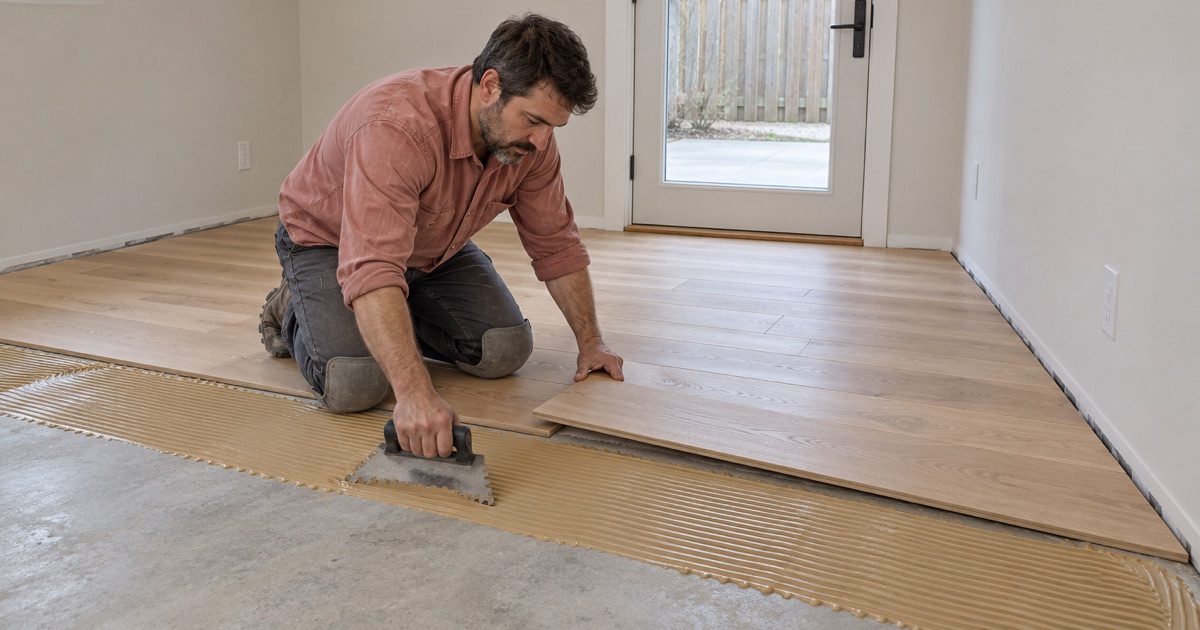
On concrete, engineered boards are usually spread into a flooring adhesive that also serves as a moisture barrier. The trowel size, the open time and the slab’s moisture all matter, and a rushed glue job leaves hollow spots that sound and feel different underfoot.
We roll or weight the boards as the adhesive sets and clean any glue off the face before it cures, since cured adhesive on a prefinished surface is hard to remove without marking it. Glue-down floors feel solid and quiet, closer to a nailed floor than a floating one.
Floating Installation
Some engineered products lock together and float over an underlayment without being fastened to the subfloor. Floating floors are quick to install and can go over some existing floors, but they need a flat base and an expansion gap at every wall to avoid buckling.
Because a floating floor moves as one sheet, heavy kitchen islands and built-in cabinets cannot sit on top of it. We plan where the floor stops and how the trim covers the gap, so the floor is free to move and the edges still look finished.
Nail-Down Or Staple-Down Installation
Over a wood subfloor, thicker engineered boards can be fastened through the tongue like solid hardwood. This feels the most like a traditional floor underfoot. We refasten and flatten the subfloor first so nails hold and the floor stays quiet.
Caring For And Refinishing Engineered Hardwood
Screen And Recoat On Engineered Floors
When the finish is dull or lightly scratched, a screen and recoat cleans and abrades the surface and adds a fresh coat without touching the wood. It works on most engineered floors regardless of wear layer, as long as the factory finish accepts a new coat. We test a small area first, because some factory finishes need a bonding step.
A recoat every few years in the busiest rooms keeps the wear in the finish and out of the thin wood layer. That habit is what lets an engineered floor with a modest wear layer last as long as many solid floors.
Full Sanding Where The Wear Layer Allows
If the wear layer is thick enough, an engineered floor can be sanded and refinished like solid hardwood, changing its color or removing deeper scratches. We measure the wear layer at a register or an edge first, and we sand more conservatively than we would on solid wood, because sanding through to the core cannot be undone.
Water Damage And Board Replacement
Engineered boards resist humidity but not standing water. After a leak, we read the floor with a moisture meter and replace swollen or delaminated boards from spare stock or a matching product, rather than tearing out the whole room when only a section is damaged.
Where insurance is involved, we document the readings, the affected area and the replacement cost room by room for the adjuster. The source of the water has to be fixed and the subfloor or slab dried before new boards go in, or the replacement will fail the same way.
- 20+ Years Experience
- Written Itemized Estimates
- Dust-Contained Sanding